Carbon footprint
Reo.pl Sp. z o.o.

We provide our customers with only 100% green electricity, actively contributing to environmental protection. We make responsibility for the planet a priority, so we also take care to minimize our own carbon footprint. Under the GHG Protocol, we have calculated and accurately monitor our emissions in two key scopes: Scope 1 (direct emissions) and Scope 2 (indirect emissions).

What is a carbon footprint?

A carbon footprint is the total sum of greenhouse gas emissions (carbon dioxide - CO2, methane - CH4, nitrous oxide - N2O, hydrofluorocarbons - HCFS, perfluorocarbons PFCS and sulfur hexafluoride - SF6) produced directly or indirectly by a person, organization, event or product.

Learn more on the blog
Nagłówek
Naglowek

Calculate the carbon footprint
of your company!

Calculating an enterprise's carbon footprint is extremely important. The knowledge gained helps identify the main sources of greenhouse gas emissions and implement a plan to reduce them.

Companies that demonstrate transparency in their environmental activities and actively reduce their carbon footprint build an image as responsible business partners. This approach strengthens their competitive position in the supply chain, increasing the trust of customers and counterparties.

Reducing the carbon footprint supports the company in its business operations, makes it easier to obtain financing from banks, and attracts consumers who are increasingly choosing sustainable companies.

How to calculate the carbon footprint?
The basis for calculating the carbon footprint for companies are organizational standards:

ISO 14064:2018

A standard that provides guidelines for quantifying and reporting GHG emissions and removals.

GHG Protocol

Greenhouse Gas Protocol, which is an international standard for measuring and reporting GHG emissions.

The carbon footprint includes direct emissions, e.g., energy consumed directly on the company's premises, and indirect emissions, e.g., purchased energy.

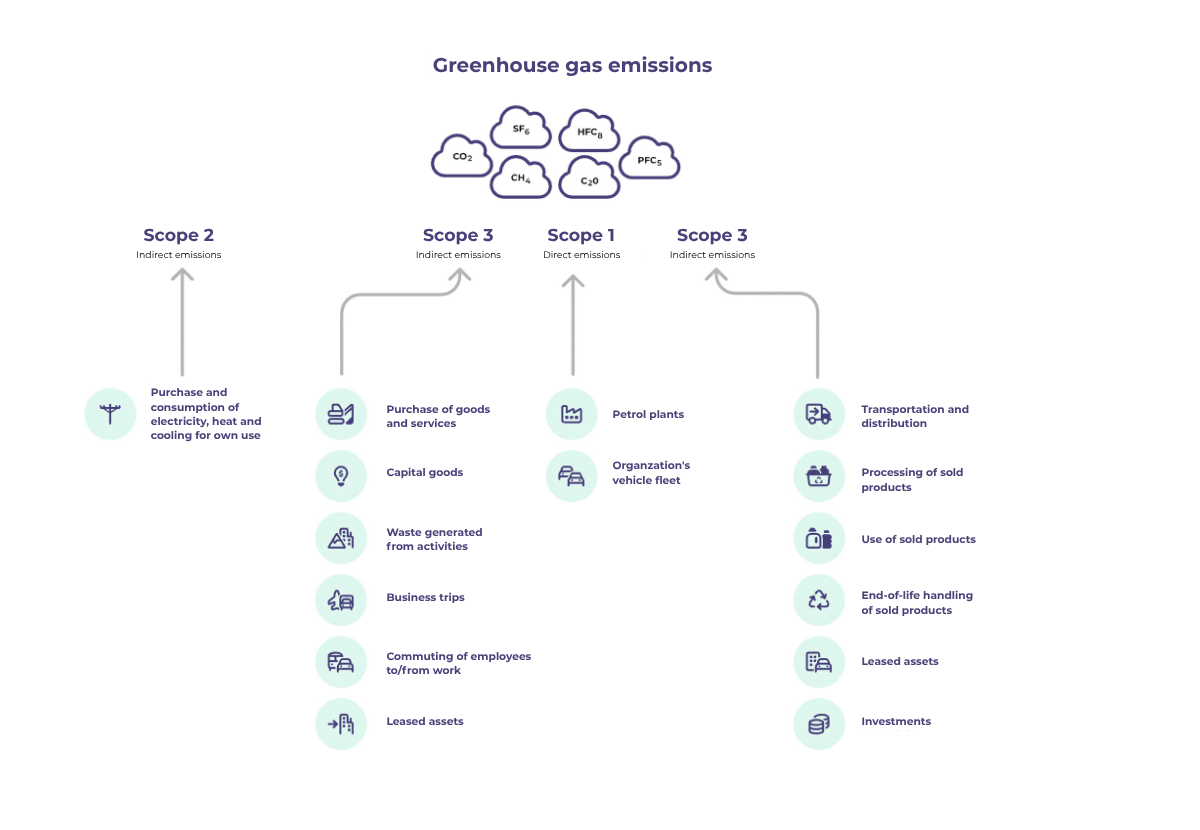
To correctly calculate GHG emissions, three ranges are taken into account, according to the GHG Protocol:

  • Scope 1 includes direct emissions generated at company-controlled facilities, including from fuel combustion in stationary (heating boilers) and mobile (vehicle fleet) installations, as well as from refrigerants and industrial processes.
  • Scope 2 is indirect emissions related to the production of purchased electricity, heat, cooling or process steam.
  • Scope 3 deals with indirect emissions from the company's environment, such as emissions from the supply chain, employee transportation, business travel and waste management.
carbon footprint estimate
Emisje gazów cieplarnianych

Carbon footprint
Reo.pl Sp. z o.o.

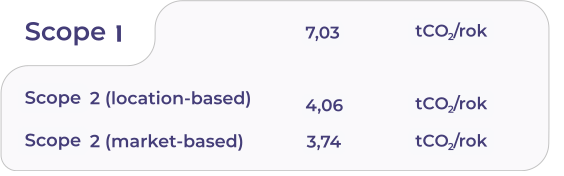
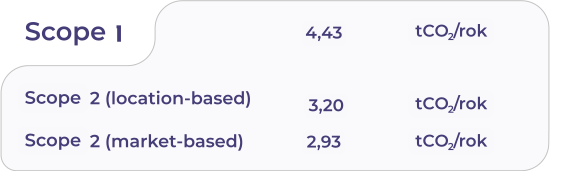
Greenhouse gas emissions in  2024in  2025

Carbon footprint Reo.pl Sp. z o.o. Scope 1 Carbon footprint Reo.pl Sp. z o.o. Scope 1
  • Scope 1 takes into account emissions related to fuel combustion in mobile sources, i.e. internal combustion vehicles in the fleet of Reo.pl Sp. z o.o.
  • Scope 2 includes indirect emissions related to the purchase of electricity and heat. We obtain 100% of our electricity from the RES installation. Heat comes from a gas boiler located in a building managed by the property owner. For this reason, emissions related to the use of thermal energy are included in Scope 2.

Emissions were calculated based on two methods:

  • location-based, which is based on location and results from energy production in the area where it is consumed,
  • market-based, which is based on the value being in the market and reflects the individual choices of companies as to which product or electricity supplier they buy.
  • Scope 1 takes into account emissions related to fuel combustion in mobile sources, i.e. internal combustion vehicles in the fleet of Reo.pl Sp. z o.o.
  • Scope 2 includes indirect emissions related to the purchase of electricity and heat. We obtain 100% of our electricity from the RES installation. Heat comes from a gas boiler located in a building managed by the property owner. For this reason, emissions related to the use of thermal energy are included in Scope 2.

Emissions were calculated based on two methods:

  • location-based, which is based on location and results from energy production in the area where it is consumed,
  • market-based, which is based on the value being in the market and reflects the individual choices of companies as to which product or electricity supplier they buy.

Compared to 2024, an increase in emissions was recorded, resulting both from the development of our operations and from one-off events.

Business growth: the increase in carbon footprint is primarily a consequence of the continued development of Reo.pl’s operations. This growth was influenced, among other factors, by an increase in employment, which led to a larger office space usage, as well as intensified use of the vehicle fleet.

One-off events: emissions in the past year were also affected by a failure of an electric vehicle in the Reo.pl fleet, which had to be temporarily replaced with a combustion engine car.

The obtained results, beyond providing general knowledge that supports building a long-term emission reduction strategy, also confirm the validity of actions already taken, related to modernizing the vehicle fleet towards zero-emission solutions.

At Reo.pl, we believe that every responsible action begins with knowledge, including measurements and calculations. Therefore, we continue to calculate our carbon footprint in order to gain the necessary insights for making informed and effective decisions in our area of operations.

How to reduce greenhouse gas emissions?

To reduce a company's greenhouse gas emissions, it makes sense to start by purchasing green electricity.
This is the fastest step toward improving your company's emissions score.

Join the green revolution

Join a community that actively supports renewable energy sources

In addition, to reduce emissions, you can implement energy-efficient technologies used in production processes. It is also worthwhile to replace the company's fleet with electric vehicles. Another very important aspect toward decarbonization is improving the energy efficiency of production buildings, such as through better thermal insulation and smart energy management systems.

Nr KRS : 0000953880, Sąd Rejonowy dla m.st. Warszawy, ;XIII Wydział Gospodarczy Krajowego Rejestru Sądowego; Wysokość kapitału; zakładowego: 490 000,00 zł;
NIP: 5213956475, REGON: 521277758